I was surprised that it had come upon us so quickly, and with very little notice as well. The University of Minnesota, along with the rest of the state, doesn’t even recognize it with a day off – perhaps their Scandinavian roots prefer to give Leif Ericson his transatlantic due. My Old World fanaticism always made this a pretty cool holiday in my mind. After all, he’s the only non-American to have a day of observance in the US.
There’s a lot that can be said about this guy so I won’t sit here and provide an entire account of Columbus’ accomplishments – that’s what specials on the History Channel are for. Instead, before this Genoese navigator discovered a few Caribbean islands and led to the eventual exploration (and exploitation) of the continental Americas, he needed support. Both financially and authoritatively, Columbus had a bit of an uphill climb before he could hit the seas.
Contrary to popular belief, it was pretty common knowledge that the Earth was spherical and not flat prior to 1492. Europeans and Asians agreed on this fact and believed that there was nothing more than vast ocean between the Canary Islands and Japan, yet it was a voyage much too long for any ship of the time. Where Columbus made some waves was in claiming that the distance the Occident and the Orient was not as great as maritime experts had assessed. Through extensive calculations, Columbus tried to prove that there was a feasible crossing. The problem was no one was on board with his proposal.
In 1485, Columbus went to Portugal to present his plan to John II, figuring that the western most country in Europe would be most interested. He asked the King for a list of conditions such as three sturdy ships, the title of “Great Admiral of the Ocean”, governor of any lands he discovers, and ten percent of all revenue of those lands. The Portuguese advisors weren’t buying it. Columbus came back three years later, but John II wasn’t too attracted by his idea anymore since Portugal had gained control of the southern tip of Africa and now had a more secure trade route to Asia.
Columbus went back to his native Genoa to try his luck but to no avail. The Veneitians wasn’t digging it either. Then, in 1486, Isabella I of Castile in Spain granted him an audience but her advisors felt the same way as the Portuguese did; Columbus’ estimations were just too short for comfort. They knew that he was on to something though, because they gave him all kinds of provisions to keep them in his favor. After conquering the final Moorish stronghold in the Iberian Peninsula in 1492, Isabella and her husband, Ferdinand II of Aragon, received him once again.
The Spanish monarchs turned him down for a second time and Columbus was devastated. Ferdinand suddenly had a change of heart and sent the royal guard to find Columbus before he headed out of Granada. Columbus was found “leaving town by mule in despair”, only to learn he would be depart from the known world on vehicle much, much larger.
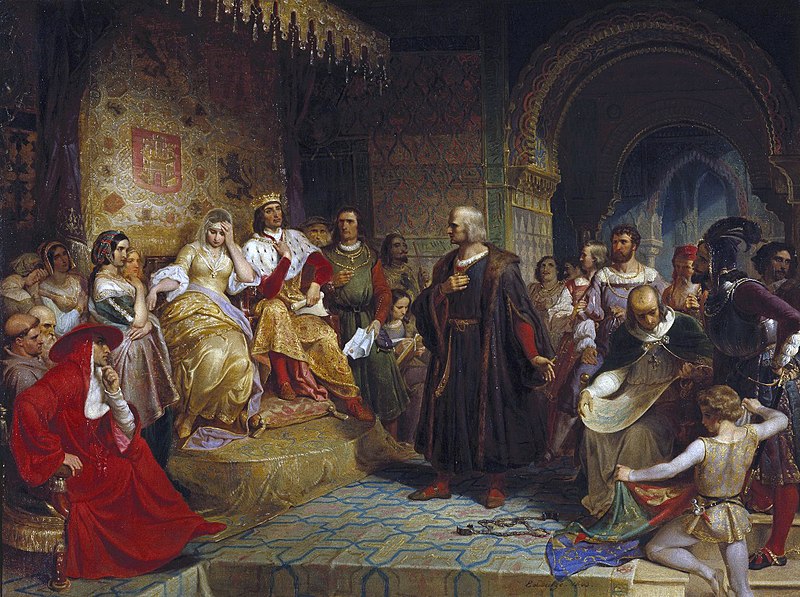
Although they were close to broke from the Reconquista, Isabella and Ferdinand generously fulfilled every aspect of Columbus’ proposition. They were especially at ease with granting him all the financial benefits of any new lands he discovered because, frankly, they didn’t think he would come back.
Interestingly enough, Columbus’ brother had successfully obtained a meeting with Henry VII of England during this same time. Had Columbus not already committed to Spain and embarked under the English crown, who knows how differently history would’ve unfolded?
Nevertheless, Columbus sailed the ocean blue in 1492 and Spain won the New World sweepstakes. The rest is history. Sure, he thought that he was in India and his calculations were ultimately incorrect, but his persistence just proves that he knew one thing and that was that it was him that was supposed to set out into the unknown. It’s more than just an accidental discovery that we should be commemorating today; it’s an entire journey, and not just a nautical one, but an unrelentingly gritty conquest of self-achievement and conviction.


No comments:
Post a Comment